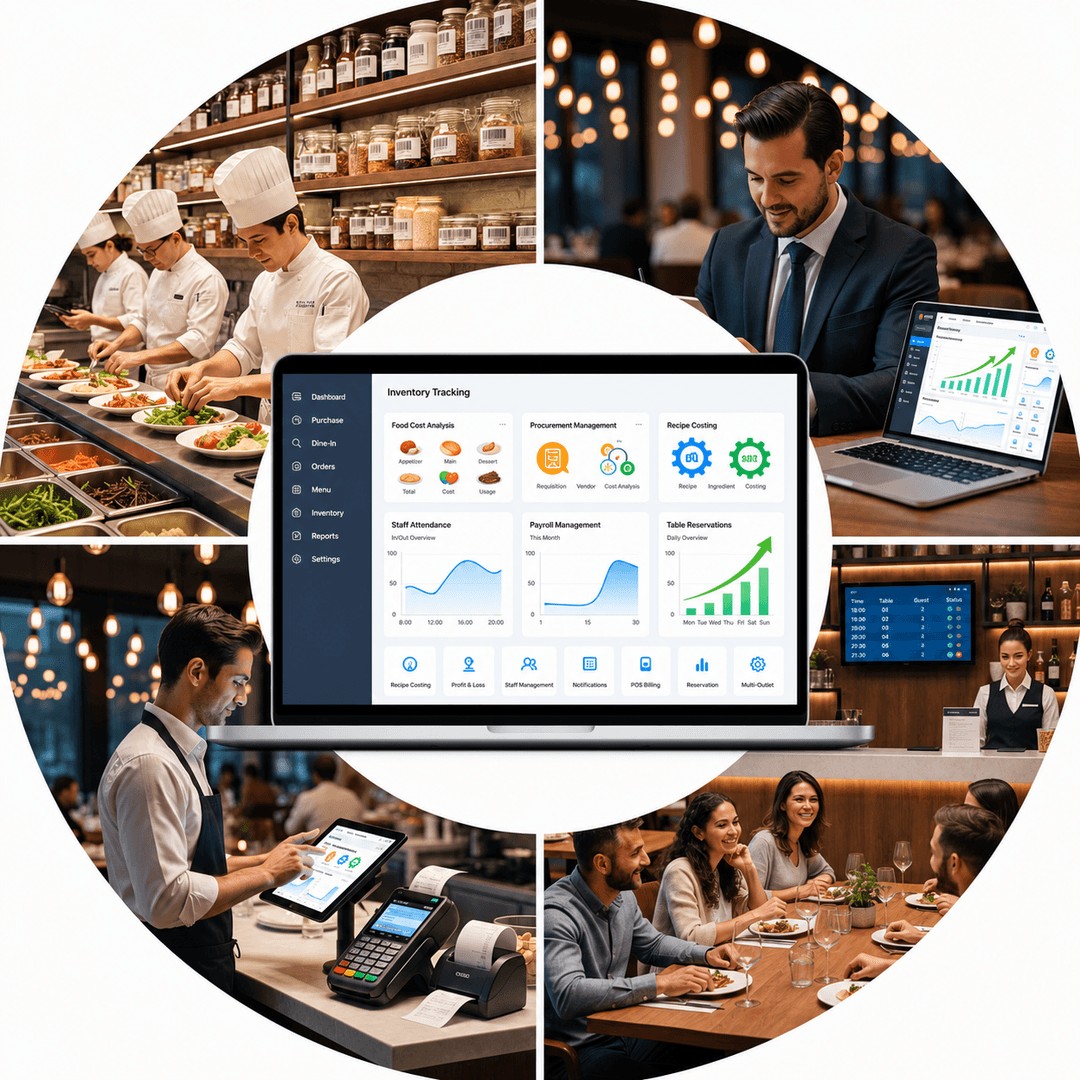

Running a profitable restaurant is about much more than serving delicious food. Behind every successful restaurant is a well-managed operation that controls expenses, minimizes waste, and maximizes efficiency.
Many restaurant owners focus heavily on increasing sales, but profitability is often determined by how effectively operational costs are managed. Food wastage, inventory discrepancies, inefficient staffing, billing errors, and poor visibility into business performance can quietly reduce profit margins, even when customer traffic is increasing.
The good news is that modern restaurant management software can help restaurants identify these challenges and address them before they become costly problems.
In Brief
Reduce inventory waste with real-time stock tracking
Control food costs through recipe and ingredient management
Improve staff productivity and labor cost management
Speed up billing and reduce manual errors
Optimize table utilization and customer flow
Monitor business performance through detailed analytics
Let's explore how restaurant management software can help reduce operational costs while improving efficiency and profitability.
Why Do Restaurant Costs Increase Even When Sales Are Growing?
Many restaurant owners are surprised when monthly sales increase but profits remain unchanged.
This usually happens because hidden operational expenses continue growing in the background. Small inefficiencies may seem insignificant individually, but together they can have a major impact on profitability.
Common cost leakages include:
Food wastage and spoilage
Inventory theft or stock discrepancies
Over-ordering ingredients
Excessive labor costs
Manual billing mistakes
Poor vendor management
Untracked discounts and complimentary items
Delayed decision-making due to lack of reports
Without accurate visibility into daily operations, these issues often go unnoticed until financial reports reveal declining margins.
Restaurant management software provides real-time operational data, helping restaurant owners identify problems early and take corrective action.
1. Reduce Inventory Waste with Real-Time Stock Tracking
Inventory is one of the largest expenses for any restaurant. Without proper monitoring, ingredients can be wasted, misplaced, overstocked, or expire before being used.
Zilicius Inventory Management helps restaurants maintain complete control over stock levels by automatically tracking ingredient consumption and inventory movement.
Every sale updates inventory in real time, allowing managers to see exactly what is available, what is being consumed, and what needs replenishment.
Benefits of Real-Time Inventory Management
Prevent over-ordering
Reduce ingredient spoilage
Avoid stock shortages
Improve purchasing accuracy
Minimize inventory discrepancies
Track stock across multiple locations
Instead of relying on manual stock checks, restaurants can make informed purchasing decisions based on accurate data.
2. Control Food Costs Through Recipe Management
Food cost management plays a critical role in restaurant profitability.
Many restaurants struggle to determine the actual cost of preparing each menu item. Without this information, pricing decisions may be based on assumptions rather than facts.
Restaurant management software allows businesses to create standardized recipes and track ingredient consumption for every dish sold.
How Recipe Management Helps
Calculate exact cost per dish
Monitor ingredient usage
Identify high-cost menu items
Reduce portion inconsistencies
Improve menu profitability
By understanding food costs at a detailed level, restaurant owners can optimize menu pricing and increase profit margins without compromising quality.
3. Improve Staff Productivity and Reduce Labor Costs
Labor expenses typically account for a significant portion of restaurant operating costs.
Poor scheduling, attendance issues, unnecessary overtime, and inefficient workforce allocation can quickly increase expenses.
Restaurant management software simplifies workforce management through automation.
Staff Management Features
Employee attendance tracking
Shift scheduling
Overtime monitoring
Leave management
Payroll support
Performance monitoring
Managers can ensure the right number of employees are available during peak hours while avoiding overstaffing during slower periods.
This helps restaurants maintain service quality while controlling labor costs.
4. Speed Up Billing and Improve Transaction Accuracy
Manual billing processes can create delays, increase errors, and negatively impact customer satisfaction.
A modern POS and restaurant management system automates billing and order processing, ensuring accuracy and efficiency.
Benefits of Automated Billing
Faster order processing
Reduced billing errors
Multiple payment options
Improved customer experience
Better transaction tracking
During busy periods, faster billing also leads to quicker table turnover, allowing restaurants to serve more customers and increase revenue.
5. Optimize Table Management and Seating Efficiency
Every empty table during peak hours represents lost revenue.
Restaurant management software helps maximize seating utilization through smart table management features.
Table Management Advantages
Real-time table availability
Reservation management
Waitlist management
Faster table turnover
Improved guest flow
Restaurants can serve more customers using existing seating capacity without increasing operational expenses.
This directly improves revenue generation while maintaining customer satisfaction.
6. Make Better Business Decisions with Advanced Analytics
One of the biggest challenges restaurant owners face is making decisions without accurate data.
Restaurant management software provides detailed reports and analytics that help owners understand exactly how the business is performing.
Key Insights Available
Best-selling menu items
Low-performing dishes
Peak business hours
Inventory consumption trends
Staff productivity reports
Daily and monthly sales reports
Profitability analysis
With real-time data available at their fingertips, restaurant owners can make informed decisions that reduce costs and improve profitability.
7. Multi-Outlet Management Made Simple
For restaurants operating multiple branches, managing inventory, sales, and operations separately can become overwhelming.
Zilicius allows restaurant owners to monitor all outlets from a centralized dashboard.
Benefits of Multi-Outlet Management
Outlet-wise sales tracking
Centralized inventory monitoring
Standardized operations
Comparative performance analysis
Consolidated business reports
This level of visibility helps businesses scale efficiently while maintaining operational consistency.
Real-World Example: Small Savings Create Big Results
Consider a restaurant that spends ₹5 lakh per month on inventory and labor.
Common monthly losses may include:
Inventory wastage: ₹20,000
Excess labor costs: ₹15,000
Billing errors: ₹5,000
Poor purchasing decisions: ₹10,000
Total avoidable losses: ₹50,000 per month
Over a year, that equals ₹6 lakh in unnecessary expenses.
With restaurant management software, many of these inefficiencies can be significantly reduced through automation, monitoring, and better decision-making.
Why Restaurants Choose Zilicius Restaurant Management Software
Zilicius is designed specifically to simplify restaurant operations and improve profitability.
Key features include:
POS Management
Inventory Management
Recipe Costing
Kitchen Order Management
Purchase Management
Vendor Management
Staff Management
Table Reservation Management
Multi-Outlet Management
Business Analytics Dashboard
Cloud-Based Accessibility
Whether you operate a cafe, quick-service restaurant, fine-dining establishment, cloud kitchen, or restaurant chain, Zilicius provides the tools needed to manage operations efficiently and reduce unnecessary costs.
Manual Management vs Zilicius
Area | Manual Process | Zilicius |
Inventory Tracking | Time-consuming | Real-time |
Billing | Error-prone | Automated |
Staff Scheduling | Manual | Digital |
Reporting | Delayed | Instant |
Multi-Outlet Control | Complex | Centralized |
Food Cost Analysis | Limited | Detailed |
Business Visibility | Partial | Complete |
Conclusion
Reducing operational costs is not about cutting corners—it's about operating smarter.
By improving inventory control, food cost management, staff productivity, billing efficiency, table utilization, and business reporting, restaurant management software helps restaurants increase profitability while delivering better customer experiences.
Zilicius Restaurant Management Software empowers restaurants with the tools they need to streamline operations, reduce waste, control expenses, and scale efficiently.
Whether you manage a single restaurant or multiple outlets, investing in the right technology can transform your business and create long-term growth.
Frequently Asked Questions
1. How does restaurant management software reduce food waste?
It tracks inventory in real time, monitors ingredient consumption, and helps prevent over-ordering and spoilage.
2. Can restaurant software improve staff productivity?
Yes. It automates attendance tracking, scheduling, payroll processes, and performance monitoring.
3. Is restaurant management software suitable for small restaurants?
Absolutely. Small restaurants benefit from improved inventory control, faster billing, and better operational visibility.
4. What features should a restaurant management system include?
Key features include POS, inventory management, recipe costing, staff management, analytics, billing, and multi-outlet support.
5. How much can restaurants save using management software?
Savings vary by business size, but reducing wastage, labor inefficiencies, and billing errors can significantly improve profitability.
6. Can restaurant management software support multiple outlets?
Yes. Multi-outlet management allows businesses to monitor sales, inventory, and performance from a centralized dashboard.
7. Is cloud-based restaurant software secure?
Modern cloud platforms use advanced security measures, backups, and access controls to protect business data.
8. Does restaurant software help with purchasing decisions?
Yes. Inventory and consumption reports help managers order the right quantities at the right time.
9. Can restaurant software integrate with POS systems?
Most modern restaurant management solutions integrate seamlessly with POS systems for accurate billing and inventory updates.
10. What is the ROI of restaurant management software?
Restaurants often achieve ROI through reduced wastage, better inventory control, improved labor efficiency, and faster decision-making.
Ready to Reduce Restaurant Costs and Improve Efficiency?
Discover how Zilicius Restaurant Management Software can help streamline operations, manage inventory, optimize staff performance, and increase profitability—all from a single platform.
Book a Free Demo Today and Experience the Zilicius Difference.
Also Read
11 Restaurant Inventory Mistakes That Are Costing You Money (How to Fix Them)