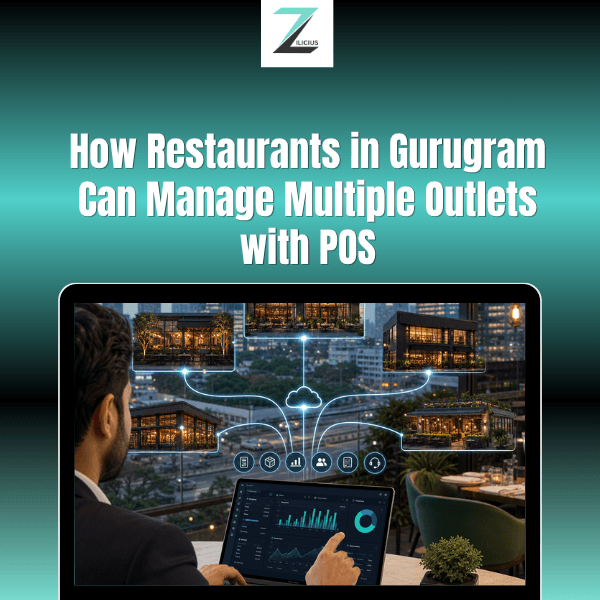

Introduction: Gurugram's Restaurant Business Operates on a Different Level
Gurugram — Cyber City, Golf Course Road, Sohna Road, the DLF phases, Sector 29 — this is a city where restaurant businesses scale fast. Running a single outlet is already demanding, but once you're managing a café in Sector 29, a QSR in Cyber Hub, and a fine-dine in Sohna Road at the same time, the real challenge begins.
More outlets mean more revenue, but they also bring more headaches: disconnected billing systems, mismatched inventory, staff following different rules across different shifts, and month-end reports that never quite match up.If multiple outlets are managed through spreadsheets or disconnected billing systems, it can become difficult to maintain centralized visibility and consistent processes across locations.
This is where a robust pos software for restaurant chains can help centralize and streamline multi-outlet operations. In this guide, we'll look at how multi-outlet restaurants in a fast-growing, competitive market like Gurugram can streamline their operations — and how Zilicius, a centralized restaurant POS, simplifies the entire process.
What Challenges Do Multi-Outlet Restaurants Face in Gurugram?
Gurugram is a unique market — a corporate crowd, high-footfall malls, delivery-heavy residential sectors, and premium dining zones all exist within the same city. This is why multi-outlet operators run into these problems most often:
1. Disconnected Billing and Inconsistent Pricing
When every outlet runs its own standalone billing system, keeping menu pricing in sync becomes difficult. For example, one outlet may price butter chicken at ₹320 while another lists it at ₹340, potentially creating customer confusion and pricing inconsistency.
2. Lack of Inventory Visibility
When stock runs out at your Golf Course Road outlet while the same ingredient sits overstocked at your Sector 14 location, it can be difficult to identify and address that mismatch without centralized visibility. The result: wastage on one side, stockouts on the other.
3. Staff Management Across Locations
Multiple outlets mean multiple teams, multiple shift schedules, and varying performance levels. Without a unified system, owners may find it difficult to identify staffing gaps, attendance patterns, or employee performance differences across outlets.
4. Reporting Nightmares
A common challenge at month-end can be consolidating information from multiple outlets — especially when each outlet maintains separate spreadsheets or reports.
5. Delivery Platform Integration Chaos
Restaurants in Gurugram may receive orders through third-party delivery platforms such as Swiggy and Zomato, adding another layer to multi-outlet order management. If every outlet's delivery integration is set up differently, order management and commission tracking both become unnecessarily complicated.
6. Maintaining Brand Consistency
Customers expect a consistent experience no matter which outlet they visit — the same menu, the same offers, the same quality of service. Maintaining that consistency across disconnected systems is nearly impossible.
Why a Centralized POS System Software for Restaurant Chains Is Essential
A modern pos system software for restaurant chains isn't just a billing tool anymore — it becomes the entire operating system of your business once you're running multiple outlets. Here are the core capabilities every multi-outlet operator needs:
Centralized Dashboard — Everything on One Screen
Owners or area managers should be able to see every outlet's real-time data on a single dashboard — sales, footfall, average order value, staff attendance, inventory levels. This means you don't have to physically visit every outlet to monitor how the business is performing.
Unified Menu Management
Launching a new item or updating a price should apply to all outlets simultaneously from a centralized system, with a single click.This can help reduce pricing inconsistencies and menu mismatches across outlets.
Cross-Outlet Inventory Tracking
Real-time stock visibility across locations also makes stock transfers easier to manage — if one outlet has excess stock and another is running short, the system can provide alerts and support stock-transfer workflows, where these features are available.
Consolidated Reporting
This is where the biggest value lies — automated, consolidated reports that combine data from every outlet into a single, clear financial picture. Sales summaries, tax-related reports, staff performance data, and other supported operational reports — all in one place.
Role-Based Access Control
Each outlet manager should only see data relevant to their own outlet, while owners or regional heads get full visibility. This maintains both security and accountability.
Point of Sale Software for Restaurant Chains: Key Features to Look For
When evaluating point of sale software for restaurant chains, these features should be non-negotiable:
Feature | Why It Matters |
Cloud-based architecture | Anywhere, anytime access — monitor outlets over the internet from any location |
Multi-location inventory sync | Real-time stock visibility, reduced wastage |
Centralized menu & pricing control | Brand consistency, faster rollout of new items or offers |
KDS (Kitchen Display System) integration | Order accuracy, faster kitchen turnaround |
Swiggy/Zomato integration | Manage supported delivery orders through a centralized workflow |
GST-ready billing | Automated tax calculation and GST-oriented billing workflows |
Staff attendance & payroll module | Centralized multi-outlet workforce management |
Consolidated analytics & reporting | Data-driven decision-making across all locations |
Offline mode support | Billing continues even when the internet goes down |
Role-based user access | Security and operational accountability |
Zilicius: A Solution Built for Gurugram's Multi-Outlet Restaurants
Zilicius is specifically designed to solve the real-world operational challenges of Indian restaurant businesses — and multi-outlet management is one of its core strengths.
1. One Dashboard, All Outlets
Zilicius's centralized dashboard gives you real-time visibility, whether you're managing a small multi-outlet operation or a larger restaurant group. Sales trends, top-performing items, peak hours — all available outlet-wise as well as consolidated across the entire chain.
2. Smart Inventory Management
Zilicius offers cross-location inventory tracking, letting you monitor stock levels in real time, get low-stock alerts, and coordinate transfers easily — even across Gurugram's densely packed outlet locations.
3. Seamless Swiggy and Zomato Integration
In a delivery-heavy market like Gurugram, Zilicius's built-in Swiggy/Zomato POS integration means you don't have to manage multiple tablets or separate systems. All orders — dine-in or delivery — land on a single POS screen.
4. KDS vs. Paper KOT — The Speed Difference
Zilicius's Kitchen Display System replaces paper-based KOTs, reducing kitchen errors and improving order fulfillment speed — especially during peak hours when order volumes spike in locations like Cyber Hub.
5. Staff and Shift Management
Attendance, shift scheduling, and performance tracking across multiple outlets can all be managed from a single system, significantly cutting down on HR overhead.
6. GST-Ready, Compliance-Friendly Billing
Zilicius generates automated GST billing that stays compliant across every outlet, so tax season doesn't turn into a scramble.
7. Consolidated Analytics for Smarter Decisions
Owners get both outlet-wise and brand-wide performance reports — enabling decisions based on data, not gut feeling.
Zilicius vs. Traditional Multi-Outlet Management: Comparison
Parameter | Traditional/Disconnected Systems | Zilicius (Centralized POS) |
Menu updates | Manual, outlet-by-outlet | One-click, all outlets simultaneously |
Inventory visibility | Siloed, delayed | Real-time, cross-location |
Delivery platform management | Separate tablets per platform | Unified dashboard integration |
Reporting | Manual consolidation, error-prone | Automated, real-time consolidated reports |
Staff management | Outlet-specific, no central view | Centralized attendance & performance tracking |
GST compliance | Manual calculation risk | Automated, compliant billing |
Scalability | Difficult to add new outlets | New outlet onboarding in minutes |
Owner visibility | Requires physical visits | Remote, real-time monitoring |
How to Set Up Multi-Outlet Restaurant Operations: A Step-by-Step Approach
If you're expanding your second or third outlet in Gurugram, or already running multiple outlets and looking to streamline your systems, here's an approach to follow:
Step 1: Choose a Central POS System
Start by selecting a cloud-based, multi-location-ready POS that supports both your current scale and future expansion.
Step 2: Standardize Menu and Pricing
Build a consistent menu structure across outlets — even if some outlets have regional variations, keep base pricing and categories consistent.
Step 3: Centralize Inventory
Implement a unified inventory system that tracks stock in real time across every outlet, minimizing both wastage and stockouts.
Step 4: Staff Onboarding and Training
Train new outlet staff on the same POS system used across all your other outlets — this improves consistency and efficiency.
Step 5: Set Up Delivery Integrations
Connect platforms like Swiggy and Zomato to your centralized POS so order management can happen from a single place.
Step 6: Establish a Reporting Cadence
Set up weekly and monthly consolidated reports so you can compare outlet-wise performance and identify underperforming locations early.
Real Business Impact: What Multi-Outlet POS Delivers
When restaurants implement centralized pos for restaurant software, these improvements typically follow:
Faster decision-making — real-time data lets owners instantly see how each outlet is performing
Reduced food wastage — cross-outlet inventory visibility cuts down over-ordering and expiry losses
Improved order accuracy — KDS integration significantly reduces kitchen errors
Time savings on reporting — automated reports replace manual spreadsheet consolidation
Better staff accountability — centralized attendance and performance tracking
Consistent customer experience — standardized menu and pricing across all locations
Scalability — adding a new outlet becomes easy, without operational disruption
Gurugram-Specific Considerations Worth Keeping in Mind
Gurugram's restaurant ecosystem comes with a few unique factors that influence POS selection:
High corporate lunch demand — areas like Cyber City and Udyog Vihar need fast billing and quick KDS speed to handle the lunch-hour rush
Both premium and budget segments — fine-dine in the DLF phases and QSR/casual dining in Sector 14/29 coexist, so the POS needs to be flexible
Delivery-heavy residential pockets — areas like Sohna Road and New Gurugram may see more delivery orders than dine-in
High staff turnover — turnover is common in the restaurant industry, so quick staff onboarding and a training-friendly interface matter
Multi-language staff base — many restaurant staff in Gurugram are more comfortable in Hindi, so a POS interface with Hinglish/regional language support speeds up adoption
Conclusion: The Right POS Is the Foundation of Multi-Outlet Success
In a competitive, fast-growing restaurant market like Gurugram, running multiple outlets successfully takes more than just good food and a good location — operational efficiency matters just as much. Disconnected systems, manual reporting, and siloed inventory management can quietly bottleneck your growth.
A centralized pos software for restaurant chains — like Zilicius — gives you the visibility and control needed to scale. Real-time dashboards, unified inventory, seamless delivery integration, and automated reporting let you manage your business efficiently, whether you're running 2 outlets or 20.
If you're looking to take your Gurugram-based restaurant chain to the next level, a robust, India-market-focused POS system like Zilicius is a smart investment — one that solves today's problems while staying ready for future expansion.
FAQs
Q1. What is the best POS system software for a multi-outlet restaurant?
A POS that's cloud-based, syncs inventory in real time, offers centralized reporting, and supports Swiggy/Zomato integration — like Zilicius — is ideal for multi-outlet restaurants.
Q2. Can POS software update the menu across multiple outlets at once?
Yes, centralized POS systems like Zilicius let you update menu items and pricing simultaneously across all outlets from a single dashboard.
Q3. How does POS software improve inventory management for multi-outlet restaurants?
Real-time, cross-location inventory tracking lets you monitor stock levels, get low-stock alerts, and coordinate transfers efficiently between outlets.
Q4. Does Zilicius integrate with both Swiggy and Zomato?
Yes, Zilicius offers built-in integration so orders from both platforms can be managed from a single POS dashboard.
Q5. How long does it take to add a new outlet with a POS like Zilicius?
Thanks to its cloud-based architecture, onboarding a new outlet typically takes just a few hours — much faster than manual setup.
Q6. Can a POS system also handle staff management across multiple outlets?
Yes, Zilicius centralizes attendance tracking, shift scheduling, and performance monitoring, keeping HR overhead manageable even across multiple locations.
Also Read
Restaurant POS Software in Haryana: Complete Guide (2026)