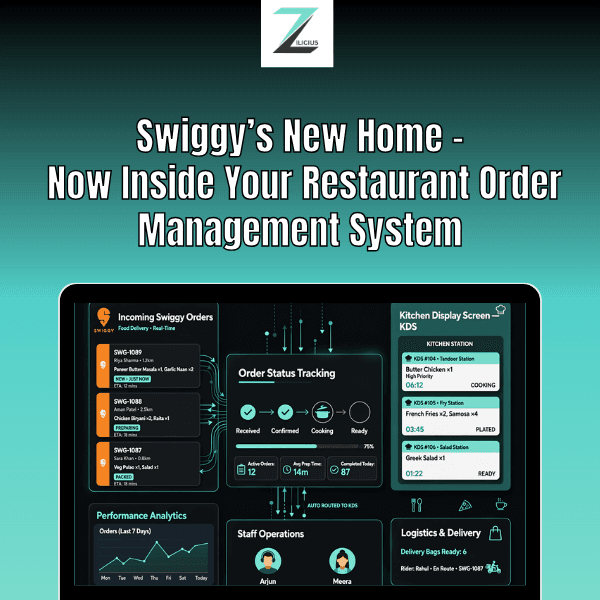

Swiggy orders no longer need to live in a separate operational silo. For restaurants using modern Restaurant Management Software, centralized order handling has become essential for maintaining operational efficiency. With Zilicius, restaurants can manage Swiggy order flow, menu coordination, billing visibility, and reporting from one unified restaurant order management system, helping teams work faster and with fewer errors. This shift matters because modern restaurant operations depend on speed, consistency, and a single source of truth across every order channel.
What is Swiggy Integration in a Restaurant Order Management System?
Swiggy integration connects your restaurant directly with a restaurant order management system, allowing online orders, menu updates, billing, kitchen workflows, and reporting to be managed from a single platform. Instead of switching between multiple dashboards, restaurants can streamline operations, improve order accuracy, and gain better visibility into business performance.
Why this shift matters
Restaurants today handle dine-in, takeaway, direct online orders, and marketplace orders at the same time. When Swiggy orders are managed separately, staff often switch between devices, dashboards, and manual updates, which increases delays and mistakes. Bringing Swiggy into the main restaurant order management system reduces that friction and gives managers a clearer operational view. This is especially important for businesses relying on Restaurant POS Software to manage dine-in, takeaway, and online orders from a single dashboard.
For businesses focused on scale, this is not just a convenience feature. It supports better order accuracy, faster kitchen coordination, and more reliable reporting across outlets. In a busy restaurant environment, every second saved in order handling can improve customer experience and staff productivity.
Why Restaurants Need Swiggy Integration
Today's restaurants manage multiple order sources including dine-in, takeaway, website orders, and food delivery platforms like Swiggy.
Without integration:
Orders may be missed
Staff switch between multiple screens
Menu updates become difficult
Billing reconciliation takes longer
Reporting becomes fragmented
With Swiggy integration, restaurants can manage everything from one centralized system, reducing operational complexity and improving service speed.
Zilicius at the center
Zilicius is built to centralize restaurant workflows so teams do not need to jump between disconnected systems. As a comprehensive Restaurant ERP Software, Zilicius helps restaurants manage orders, inventory, billing, and reporting from one platform. By placing Swiggy inside the same dashboard used for order handling, billing, and reporting, Zilicius helps restaurants manage operations from a single control layer. That means fewer manual interventions and more consistent execution across the day.
This kind of integration is especially useful for multi-outlet businesses, cloud kitchens, and high-volume restaurants. Businesses operating as Cloud Kitchen Management Software users can benefit significantly from centralized order processing and delivery management. Instead of treating Swiggy as an external platform, the order becomes part of the same operational flow as direct and offline orders. The result is a cleaner workflow for staff and better visibility for owners.
Core capabilities
A strong Swiggy-connected restaurant order management system should do more than display orders. It should support the full lifecycle of the order, from acceptance to kitchen execution and reporting. Zilicius can position this experience around the following capabilities:
Real-time order visibility.
Faster order acceptance and workflow routing.
Menu synchronization across channels.
Billing and sales tracking in one place.
Outlet-level reporting and performance analysis.
Reduced manual order entry and fewer errors.
Integrated Food Delivery Management Software capabilities help restaurants handle online orders more efficiently while reducing operational delays. These features matter because restaurants need operational continuity, not just data display. When Swiggy is integrated directly into the order management system, staff can focus on preparing food and serving customers instead of managing platform fragmentation.
Manual Swiggy Management vs Integrated Restaurant Order Management System
Feature | Manual Process | Zilicius |
Order Acceptance | Multiple Dashboards | Single Dashboard |
Menu Updates | Manual | Centralized |
Reporting | Separate Reports | Unified Reports |
Billing Visibility | Limited | Real-Time |
Error Chances | Higher | Lower |
Staff Productivity | Moderate | High |
Menu sync and accuracy
One of the biggest operational pain points in marketplace ordering is menu inconsistency. A dish may be out of stock, priced differently, or renamed across platforms, which creates confusion for customers and staff. A properly integrated system helps maintain menu consistency and reduces the risk of order mismatch. An advanced Online Order Management Software solution ensures menu updates remain consistent across all ordering channels.
Zilicius can solve this by keeping menu updates centralized. When a restaurant changes an item, the update can reflect more smoothly across Swiggy and internal operations, lowering the chance of cancellations or refund requests. This is especially valuable for restaurants that run frequent promotions or rotate seasonal items.
How Does Menu Synchronization Improve Restaurant Operations?
Menu synchronization ensures that item availability, pricing, descriptions, and promotions remain consistent across Swiggy and restaurant systems.
Benefits include:
Fewer order cancellations
Reduced customer complaints
Better inventory management
Accurate pricing
Improved customer experience
Faster kitchen execution
Once a Swiggy order enters the restaurant order management system, the kitchen team should receive it without delay. This creates a more efficient Kitchen Order Management System that improves preparation speed and order accuracy. Systems built for integration often use web hook-style order transfer or automated routing to speed up processing. That speed can make a meaningful difference during lunch peaks, dinner rushes, and weekend surges.
Zilicius can highlight kitchen readiness by connecting order intake with KOT workflows, prep queues, or display screens. This helps the kitchen prioritize orders correctly and keeps front-of-house staff aligned with what is happening behind the counter. Faster hand off between order capture and preparation usually means fewer missed orders and better delivery turnaround.
How Swiggy Integration Improves Kitchen Efficiency
When online orders automatically flow into the kitchen workflow, restaurants can reduce delays caused by manual order entry.
Benefits include:
Faster order preparation
Better order prioritization
Reduced communication gaps
Improved peak-hour management
Better delivery performance
Better Billing and Tracking
Managing Swiggy orders inside one system also improves billing visibility. Modern Restaurant Billing Software solutions help restaurant owners monitor revenue, settlements, and transaction performance more effectively. Restaurants can track orders, revenue, settlement status, and commission-related data more easily when everything is stored in a common dashboard. That makes end-of-day reconciliation simpler and reduces the time spent matching platform reports against internal records.
Zilicius can present this as a practical business benefit for owners and managers. Instead of hunting through multiple reports, they can review sales performance, outlet-wise trends, and channel-level data in one place. For multi-location businesses, this creates stronger control over financial operations and reduces reporting gaps. As a scalable Multi Outlet Restaurant Software, Zilicius enables restaurant owners to monitor sales, orders, and performance across multiple locations from a centralized dashboard.
Business Impact of Centralized Billing and Reporting
Restaurants that manage online and offline sales from one platform gain better financial visibility.
This helps:
Track outlet performance
Monitor Swiggy revenue
Simplify settlement reconciliation
Analyze customer ordering trends
Improve business decision-making
Operational Benefits
The main value of this integration is operational efficiency. Restaurants investing in Restaurant Automation Software can reduce manual tasks and improve team productivity across departments. Restaurants gain fewer manual steps, lower error rates, and better coordination between Swiggy orders and internal workflows. That improvement can have a direct impact on service speed, customer satisfaction, and team productivity.
Some of the clearest benefits include:
Fewer missed or delayed orders.
Better staff coordination during rush hours.
More accurate menu and pricing updates.
Easier reconciliation of settlements and commissions.
Better visibility into order performance across outlets.
For owners, this means stronger control. For managers, it means fewer interruptions. For staff, it means a simpler and more predictable working environment.
The Growing Importance of Restaurant Automation
As online food delivery continues to grow, restaurants are increasingly investing in integrated restaurant technology solutions. Industry reports indicate that restaurants using automation and centralized order management systems can significantly reduce order processing time, improve operational efficiency, and enhance customer satisfaction.
For businesses handling high order volumes, a unified restaurant order management system helps reduce operational bottlenecks and improves overall workflow performance.
Does Swiggy Integration Improve Restaurant Efficiency?
Yes. Restaurants using integrated order management systems often experience:
Faster order processing
Better operational control
Reduced manual workload
Improved order accuracy
Higher staff productivity
An integrated system helps restaurants scale operations without increasing operational complexity.
Content Angle for Zilicius
The best angle for Zilicius is not just “Swiggy integration,” but “one system for everything a restaurant needs.” That positions the product as a workflow hub rather than a simple connector. It also matches how restaurant buyers think: they want fewer tools, clearer dashboards, and less operational chaos.
This article should frame Zilicius as a practical, modern solution for restaurants that want to bring third-party orders into their own operating system. That message is especially strong for cloud kitchens, fast-service restaurants, and growing brands that need repeatable processes. It also aligns with the market trend toward unified operations rather than fragmented tools.
Why Zilicius Is More Than Just Swiggy Integration
While Swiggy integration is a valuable feature, modern restaurants need much more than order connectivity. They need a centralized platform that manages operations, billing, reporting, inventory, menu updates, and customer service from one place.
Zilicius combines the capabilities of Restaurant Management Software, Restaurant POS Software, Restaurant ERP Software, Restaurant Billing Software, Online Order Management Software, and Cloud Kitchen Management Software into a single platform designed for modern restaurant operations.
Whether managing a single outlet, a growing cloud kitchen, or a multi-location restaurant chain, Zilicius helps businesses simplify workflows, improve operational visibility, and scale efficiently.
Customer Pain Points Solved
Restaurants usually adopt Swiggy integration because they want to solve daily operational problems. These include order delays, staff confusion, manual billing, menu mismatches, and poor visibility into performance. A unified system helps remove those pain points by making order handling simpler and more consistent.
Zilicius can speak directly to these frustrations. The brand message should show that the system reduces complexity, improves speed, and supports better control over day-to-day restaurant operations. That makes the product easier to understand and more appealing to decision-makers.
Who Can Benefit From Swiggy Integration?
Swiggy integration is ideal for:
Restaurants
Quick Service Restaurants (QSRs)
Cafes
Cloud Kitchens
Multi-Outlet Restaurant Chains
Franchise Restaurant Businesses
Any restaurant handling high order volumes can benefit from centralized order management.
Frequently Asked Questions
What is Swiggy integration?
Swiggy integration connects online food delivery orders directly with restaurant software.
Can Swiggy orders be managed from one dashboard?
Yes, integrated restaurant management software allows centralized order handling.
Does Swiggy integration reduce order errors?
Yes, automation reduces manual entry mistakes.
Is Swiggy integration useful for cloud kitchens?
Absolutely. Cloud kitchens benefit from faster order processing and centralized management.
Can restaurants track Swiggy revenue in one system?
Yes, integrated reporting provides visibility into online sales and settlements.
How does menu synchronization work?
Menu changes can be managed centrally and reflected across connected platforms.
Can multi-outlet restaurants use Swiggy integration?
Yes, it helps manage multiple locations from one platform.
Why choose Zilicius for restaurant order management?
Zilicius combines order management, billing, reporting, menu synchronization, and operational control into one system.
Conclusion
Managing Swiggy orders separately can create unnecessary complexity for restaurants that already handle multiple sales channels. By bringing Swiggy orders, menu updates, billing, reporting, and kitchen workflows into a single restaurant order management system, businesses can improve efficiency, reduce errors, and gain better operational visibility.
Zilicius helps restaurants simplify daily operations through centralized management, making it easier to scale, serve customers faster, and maintain control across every order channel.
Also read
10 Ways Restaurant POS Software Improves Order Accuracy and Service Speed