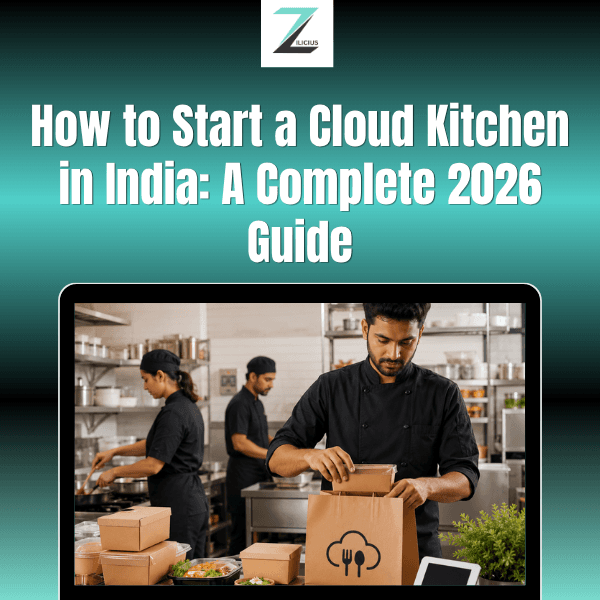

India's food delivery market has exploded over the past few years, and cloud kitchens — also called dark kitchens or virtual restaurants — have become one of the most capital-efficient ways to enter the food business. Unlike a traditional dine-in restaurant, a cloud kitchen operates without a storefront, fulfilling orders exclusively through platforms like Swiggy, Zomato, and your own website or app.
If you've been wondering how to start a cloud kitchen in India, this guide walks you through every step — from licensing and location to technology and marketing — so you can launch with confidence and avoid the costly mistakes most first-time operators make. Along with kitchen setup, licensing, and marketing, choosing the right Cloud Kitchen Management Software has become equally important for operators looking to scale efficiently, improve operational visibility, and maintain profitability.
What Is a Cloud Kitchen?
A cloud kitchen is a delivery-only food business that operates from a commercial kitchen space without any dine-in seating. Orders are placed online and prepared for delivery or takeaway. Because there's no need for a dining area, prime retail frontage, or a large front-of-house team, cloud kitchens typically cost 60-70% less to set up than a full-service restaurant.
This model has gained massive traction in Indian cities such as Bengaluru, Mumbai, Delhi NCR, Hyderabad, and Pune, driven by rising smartphone penetration, UPI-based payments, and the convenience-first habits of urban consumers.
Why Cloud Kitchens Are Booming in India
A few factors are fueling this growth:
Lower capital requirements — no need for expensive real estate in high-footfall areas
Faster breakeven — smaller teams and leaner overheads mean quicker profitability
Multi-brand potential — a single kitchen can run 2-3 virtual brands targeting different cuisines or price points
Platform-driven discovery — Swiggy and Zomato bring built-in customer demand without heavy marketing spend
Flexible scaling — you can test a concept in one city and replicate it elsewhere with minimal rework
Why Many Cloud Kitchens Fail Despite Growing Demand in India
While the cloud kitchen industry is growing rapidly, many operators struggle to achieve profitability.
Common reasons include:
• Poor menu planning
• High food wastage
• Inventory mismanagement
• Excessive dependency on discounting
• Lack of cost visibility
• Inconsistent food quality
• Weak customer retention
• Manual operations
Successful cloud kitchens focus not only on sales growth but also on operational efficiency and profitability.
Step 1: Choose Your Cloud Kitchen Business Model
Before you start a cloud kitchen in India, decide which model fits your goals and budget:
Single-brand model: One kitchen, one menu, one brand identity. Best for first-time operators who want to perfect a concept before expanding.
Multi-brand model: Multiple virtual restaurant brands operating from the same kitchen infrastructure, each targeting a different cuisine or customer segment (e.g., biryani, healthy bowls, desserts). This maximizes kitchen utilization and delivery platform visibility.
Commissary/shared kitchen model: Renting kitchen space and equipment from a shared facility provider, reducing upfront investment significantly — ideal for testing a concept before committing to a dedicated space.
Franchise cloud kitchen model: Partnering with an established brand that provides the recipes, training, and supply chain, in exchange for franchise fees and royalties.
Step 2: Conduct Market Research and Define Your Menu
Successful cloud kitchens are built around a focused, delivery-friendly menu rather than trying to be everything to everyone. When planning your menu:
Analyze demand data on Swiggy and Zomato for your target locality
Identify cuisine gaps or underserved price points in your delivery radius
Choose dishes that travel well and retain quality after 20-30 minutes in transit
Keep the menu tight (15-25 items) to simplify inventory, reduce food waste, and speed up order preparation
Price competitively while protecting your margins, factoring in platform commissions of 18-30%
Understanding Cloud Kitchen Unit Economics
Before launching, operators should understand key profitability metrics:
• Food Cost Percentage
• Packaging Cost
• Delivery Commission
• Labor Cost
• Rent-to-Revenue Ratio
• Average Order Value (AOV)
• Customer Acquisition Cost (CAC)
Monitoring these metrics helps ensure long-term profitability rather than focusing only on order volume.
Step 3: Register Your Business and Obtain Licenses
Operating legally is non-negotiable, and Indian food businesses require several registrations and licenses before launch:
FSSAI License: Mandatory for any food business in India. Depending on your turnover, you'll need either a Basic Registration, State License, or Central License from the Food Safety and Standards Authority of India.
GST Registration: Required if your annual turnover exceeds the prescribed threshold, and necessary for invoicing through delivery platforms.
Shop and Establishment Act License: Issued by your state's labour department, applicable to any commercial kitchen premises.
Fire Safety NOC: A No Objection Certificate from the local fire department confirming your kitchen meets fire safety norms.
Trade License: Issued by your municipal corporation, permitting you to operate a food business at a specific location.
Eating House License: Required by the local police department in most cities for food preparation and delivery businesses.
Processing times vary by state, so it's wise to begin the licensing process at least 6-8 weeks before your planned launch date.
Step 4: Select the Right Location
Even though cloud kitchens don't need dine-in space, location still matters enormously for delivery efficiency and cost control:
Choose a location central to your target delivery radius (typically 3-5 km) to keep delivery times short and food quality high
Prioritize areas with strong residential or office density and high order volumes on delivery platforms
Look for commercial or industrial zoning that permits food production, with lower rent than retail-facing properties
Ensure adequate water supply, drainage, and electrical load for commercial kitchen equipment
Factor in ease of access for delivery partners, including parking and loading space
Step 5: Set Up Your Kitchen Infrastructure
Your kitchen layout should be optimized for speed, hygiene, and consistency rather than aesthetics. Core requirements include:
Commercial-grade cooking equipment suited to your menu (tandoors, fryers, griddles, ovens)
Adequate refrigeration and cold storage to maintain ingredient freshness
A dedicated packing station to streamline order assembly and reduce delivery time
Proper ventilation and exhaust systems compliant with fire safety norms
Hygiene infrastructure, including handwashing stations and pest control measures
Backup power, since outages directly translate to lost orders
Budget for kitchen setup in India typically ranges from ₹5-15 lakhs depending on city, scale, and equipment quality, though shared kitchen models can bring this down considerably.
Step 6: Build Your Team
A lean, well-trained team is critical to consistent food quality and order turnaround:
Head chef or kitchen manager to oversee food quality and standardize recipes
Line cooks proportional to your menu complexity and expected order volume
A packing and dispatch coordinator to manage outgoing orders
A delivery liaison if you're managing your own fleet alongside platform delivery partners
Standard Operating Procedures (SOPs) for every dish are essential — they ensure consistency even as you scale to multiple kitchens or shifts.
Step 7: Onboard Swiggy and Zomato
Delivery aggregators are the primary customer acquisition channel for most cloud kitchens in India. The onboarding process typically involves:
Submitting your FSSAI license, GST details, and bank account information
Uploading high-quality menu photography, since visuals directly impact conversion rates on these platforms
Setting competitive delivery radius and minimum order values
Running platform-sponsored ads and participating in promotional campaigns during your launch phase to build initial order volume and reviews
Maintaining a strong rating (above 4.2) and quick order acceptance times directly affects your visibility in platform search rankings, so operational discipline matters as much as food quality.As order volumes grow across multiple delivery platforms, many operators adopt Food Delivery Management Software to centralize orders, customer data, platform integrations, and reporting workflows.
Step 8: Invest in the Right Restaurant Technology
As operations become more complex, many operators move from spreadsheets and manual tracking to Restaurant Management Software that centralizes inventory, orders, billing, analytics, and reporting.
This is where many new cloud kitchen owners fall behind. Manually juggling multiple delivery platform dashboards, tracking inventory on spreadsheets, and reconciling payments by hand simply doesn't scale. A dedicated Cloud Kitchen Software platform helps operators manage inventory, orders, billing, recipe costing, and performance analytics through a centralized dashboard. A cloud-based restaurant management and POS system brings every part of your operation onto a single screen:
Unified order management — accept and track orders from Swiggy, Zomato, your own app, and walk-in/takeaway customers in one dashboard, eliminating tablet-switching chaos during rush hours
Real-time inventory tracking — automatically deduct stock as orders are placed, get low-stock alerts, and reduce food wastage
Multi-brand and multi-kitchen management — run several virtual brands or expand to new cities from a single control panel
Sales and performance analytics — identify your best-selling dishes, peak order hours, and platform-wise profitability
UPI and digital payment integration — reconcile payments seamlessly across Razorpay, UPI, and card transactions
Automated billing and GST-compliant invoicing — save hours of manual accounting work every week
As order volumes increase, operational complexity grows rapidly.
Without the right technology, cloud kitchens often struggle with:
• Order delays
• Inventory leakage
• Cost overruns
• Reporting inaccuracies
• Multi-brand coordination challenges
This is why modern cloud kitchens increasingly rely on restaurant management platforms to centralize operations and improve visibility.
This is exactly the gap that a modern Restaurant Management Software platform like Zilicius is built to close. Zilicius is a cloud-based restaurant management and POS platform designed for India's food businesses — including cloud kitchens, multi-brand operations, and delivery-first models. With Zilicius, you get centralized order management across Swiggy, Zomato, and direct channels, real-time inventory and recipe-level cost tracking, GST-ready billing, and performance dashboards that show you exactly where your kitchen is making money and where it's leaking margin. For operators running multiple virtual brands from one kitchen, Zilicius's multi-outlet management makes it possible to scale without adding operational headcount.
Scaling from One Brand to Multiple Virtual Brands
One of the biggest advantages of a Multi Brand Cloud Kitchen model is the ability to generate additional revenue streams using the same kitchen infrastructure.
Examples include:
• Biryani Brand
• North Indian Brand
• Chinese Brand
• Healthy Bowl Brand
• Dessert Brand
With proper inventory and recipe management, operators can increase revenue without proportionally increasing costs. A well-executed Multi Brand Cloud Kitchen strategy can significantly improve kitchen utilization, order volume, and overall profitability.
Managing a Cloud Kitchen Manually vs Using Restaurant Management Software
Manual Operations | With Restaurant Software |
Multiple tablets | Unified dashboard |
Spreadsheet inventory | Real-time inventory |
Manual billing | Automated billing |
Delayed reports | Live analytics |
Stock shortages | Automated stock alerts |
Difficult multi-brand management | Centralized management |
Step 9: Plan Your Marketing Strategy
Beyond platform visibility, building a recognizable brand helps you reduce long-term dependence on aggregator commissions:
Build a presence on Instagram and Facebook with strong food photography and short-form video content
Encourage and respond to customer reviews on Swiggy and Zomato to improve platform ranking
Offer first-order discounts and combo deals to drive trial
Build a direct ordering channel (website or WhatsApp ordering) to reduce commission dependency over time
Partner with local influencers for launch-phase visibility in your delivery radius
Step 10: Track Costs and Optimize for Profitability
Cloud kitchens operate on thin margins, so disciplined cost tracking is essential from day one:
Monitor food cost percentage (ideally 28-35% of menu price)
Track platform commission impact on net margins per order
Review packaging costs, which can quietly erode profitability if not negotiated well
Analyze order-level profitability by dish and by platform to refine your menu over time
Key Metrics Every Cloud Kitchen Should Track
Successful operators monitor:
• Daily Order Volume
• Average Order Value
• Food Cost Percentage
• Kitchen Preparation Time
• Customer Ratings
• Repeat Order Rate
• Platform-Wise Revenue
• Menu Item Profitability
Data-driven decision-making is often the difference between growth and stagnation.
Common Mistakes to Avoid
Launching with an overly large menu that slows down kitchen operations
Ignoring packaging quality, which directly affects food presentation and customer reviews
Underestimating licensing timelines and delaying launch
Relying solely on delivery platforms without building any direct customer relationship
Operating without a proper POS and inventory system, leading to stockouts, wastage, and reconciliation errors
How Zilicius Helps Cloud Kitchens Scale Efficiently
Running a cloud kitchen successfully requires more than great food.
Operators need visibility into orders, inventory, food costs, profitability, and customer behavior.
Zilicius helps cloud kitchens centralize operations through:
• Order Management
• Inventory Tracking
• Recipe Costing
• Swiggy & Zomato Integration
• Multi-Brand Management
• Real-Time Analytics
• GST Billing
• Multi-Outlet Control
This enables operators to make faster decisions, reduce wastage, and scale efficiently.
Final Thoughts
Starting a cloud kitchen in India in 2026 offers a genuinely lower-risk path into the food business compared to a traditional restaurant — but success still depends on disciplined execution: the right licenses, a focused menu, efficient kitchen operations, and technology that keeps every part of the business visible and controllable.
As your order volumes grow across Swiggy, Zomato, and your own channels, manual processes quickly become the biggest constraint on growth. A platform like Zilicius gives cloud kitchen operators the centralized visibility and control needed to scale confidently — from a single kitchen to a multi-brand, multi-city operation.
Ready to streamline your cloud kitchen operations? Book a free demo with Zilicius today and see how a unified restaurant management platform can help you launch faster, run leaner, and grow with confidence.
Frequently Asked Questions
1. How much does it cost to start a cloud kitchen in India?
Costs typically range from ₹5-15 lakhs depending on city, kitchen size, and equipment quality. Shared/commissary kitchen models can bring this down to ₹2-5 lakhs since you avoid heavy upfront investment in real estate and equipment.
2. What licenses are required to start a cloud kitchen in India?
You'll need an FSSAI license, GST registration, Shop and Establishment Act license, Fire Safety NOC, Trade License from your municipal corporation, and an Eating House License from local police authorities.
3. Is a cloud kitchen profitable in India?
Yes, cloud kitchens can be profitable due to lower overheads compared to dine-in restaurants, but margins depend heavily on managing food cost percentage (28-35%), platform commissions, and packaging costs efficiently.
4. How long does it take to start a cloud kitchen?
With licensing, kitchen setup, and platform onboarding, most operators can launch within 2-3 months, though licensing timelines vary by state and should be started early.
5. Do I need a dine-in license for a cloud kitchen?
No. Since cloud kitchens don't offer dine-in seating, you don't need dine-in-specific approvals, though you still require an Eating House License and FSSAI registration for food preparation and delivery.
6. Which is better — single-brand or multi-brand cloud kitchen model?
Multi-brand models maximize kitchen utilization and platform visibility but require stronger operational systems. First-time operators often start single-brand to perfect their concept before expanding to multiple virtual brands.
7. How do I manage orders from multiple platforms like Swiggy and Zomato?
A Restaurant POS Software platform like Zilicius allows operators to manage orders from Swiggy, Zomato, direct websites, takeaway channels, and customer databases through a single dashboard.
8. What is the ideal delivery radius for a cloud kitchen?
Most successful cloud kitchens operate within a 3-5 km radius to maintain food quality and delivery speed, though this can vary by cuisine type and packaging durability.
9. What is the difference between a cloud kitchen and a traditional restaurant?
A cloud kitchen operates only for delivery and takeaway, while traditional restaurants serve dine-in customers and require front-of-house infrastructure.
10. Can one cloud kitchen operate multiple brands?
Yes. Many operators run multiple virtual brands from the same kitchen to maximize infrastructure utilization and revenue potential.
11. How do cloud kitchens manage inventory efficiently?
Most successful operators use restaurant management software to track stock levels, ingredient consumption, and food costs in real time.
12. Do cloud kitchens need POS software?
Yes. POS and restaurant management systems help manage orders, inventory, billing, analytics, and multi-platform integrations efficiently.
13. How can cloud kitchens reduce food wastage?
By using recipe-based inventory management, forecasting demand accurately, and monitoring stock consumption through software systems.
14. Do cloud kitchens need Restaurant POS Software?
Yes. Restaurant POS Software helps cloud kitchens manage billing, inventory, order processing, analytics, kitchen operations, and platform integrations more efficiently while reducing manual effort.
Also read
How Restaurant Software Helps Improve Customer Experience