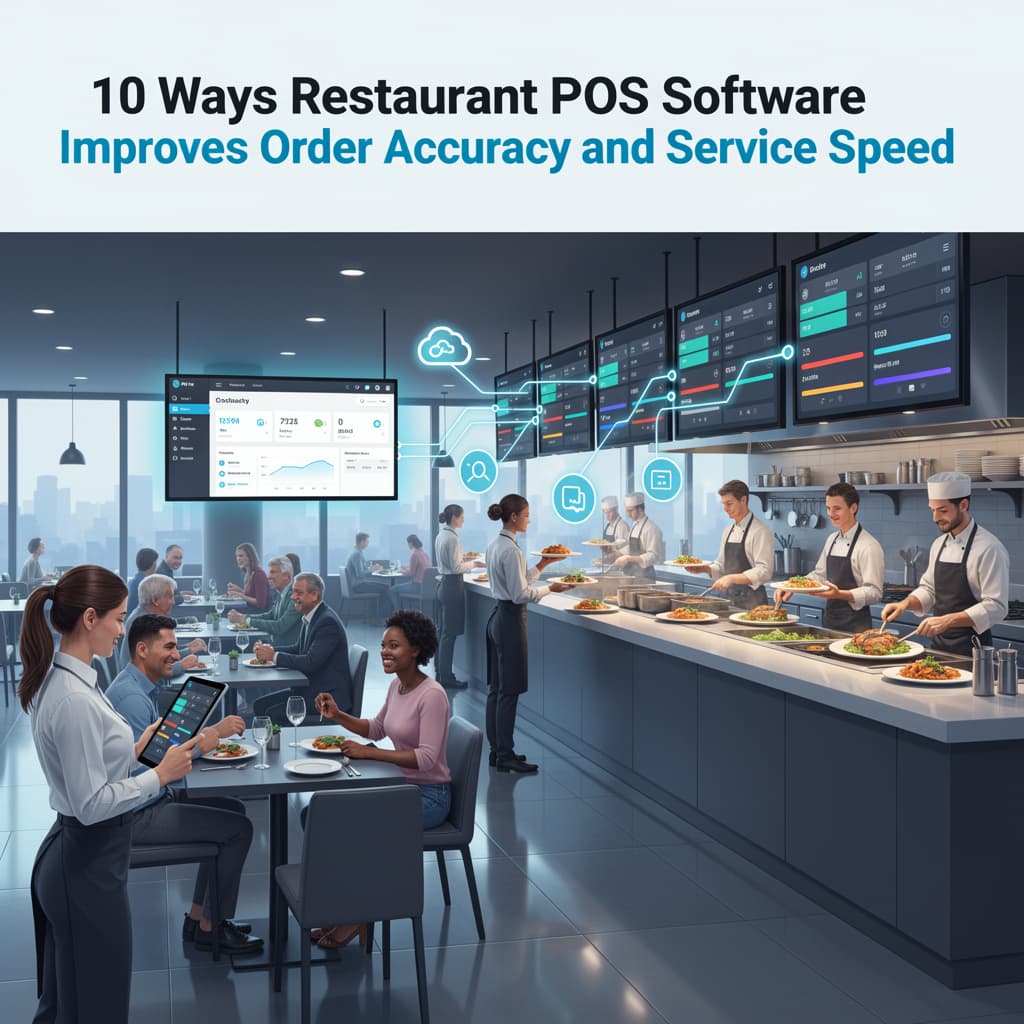

Introduction: Why Order Accuracy and Speed Define Your Restaurant's Success
In the restaurant business, two things can make or break a guest's experience faster than anything else: getting the order wrong and making them wait too long.
A wrong order doesn't just waste food and money — it frustrates customers, undermines your staff's confidence, and in the age of online reviews, finds its way onto Google before the guest has even left the car park. Similarly, slow service — whether at the counter, tableside, or in the kitchen — erodes the experience even when the food is exceptional.
The good news is that both problems share a common solution: the right restaurant POS software.
Modern Point of Sale systems have evolved far beyond simple cash registers. Today's restaurant POS platforms are intelligent, integrated ecosystems that connect front-of-house staff, kitchen teams, and management in real time — eliminating the friction, miscommunication, and manual error that slow restaurants down and cause orders to go wrong.
Zilicius is built specifically to solve these challenges. In this article, we break down 10 concrete ways that restaurant POS software improves order accuracy and service speed — and how each one translates into a better experience for your guests and a stronger bottom line for your business.
Quick Summary
Restaurant POS software improves order accuracy and service speed by digitizing order entry, reducing communication errors, streamlining kitchen workflows, automating menu updates, and enabling real-time coordination between staff and kitchen teams. Modern restaurant POS systems like Zilicius help restaurants reduce wait times, improve customer satisfaction, increase table turnover, and enhance operational efficiency.
Key Benefits of Restaurant POS Software at a Glance
Benefit | Impact |
Digital Order Entry | Fewer order mistakes |
Kitchen Display System | Faster kitchen communication |
Modifier Management | Accurate customization |
Integrated Payments | Faster table turnover |
Inventory Integration | Better stock control |
Analytics Dashboard | Improved decision making |
Common Causes of Order Errors and Slow Service in Restaurants
Even experienced restaurant teams struggle with operational challenges that impact customer experience.
Some of the most common causes include:
Handwritten order mistakes
Lost kitchen tickets
Communication gaps between staff and kitchen
Incorrect menu modifications
Delayed order routing
Inventory and menu mismatches
Manual payment processing delays
Inadequate staff training
Restaurant POS software helps eliminate these issues through automation, real-time communication, and centralized restaurant operations management.
1. Digital Order Entry Eliminates Handwriting Errors
It sounds simple, but the single biggest source of order inaccuracy in restaurants is still handwritten tickets. Illegible handwriting, ambiguous abbreviations, and notes scrawled in a rush during a busy service are a recipe for mistakes — and mistakes mean remade dishes, wasted ingredients, and unhappy customers.
Restaurant POS software replaces handwritten orders with clean, structured digital entries. When a server takes an order on a Zilicius POS terminal or handheld device, every item is selected from a clearly labelled, categorised menu. There's no ambiguity about what's been ordered, how it should be prepared, or what modifications have been requested.
The order that appears on the kitchen display is exactly what the customer asked for — formatted clearly, every time. This single change alone can dramatically reduce the number of orders that need to be remade during a service.
2. Table side and Handheld Ordering Speeds Up the Entire Service Cycle
In a traditional table service setup, the ordering process involves multiple trips: the server takes the order, walks to a terminal, enters it, and then the kitchen begins preparation. In a busy restaurant, those trips add up — and every minute spent walking between tables and terminals is a minute not spent serving guests.
Handheld POS devices and tableside ordering change this entirely. With Zilicius, servers can take orders directly at the table on a handheld device, and those orders are transmitted to the kitchen instantly — before the server has even moved on to the next table.
The benefits cascade through the entire service cycle:
Kitchens receive orders faster and can begin preparation sooner
Servers spend more time with guests rather than walking to terminals
Table turn times decrease, increasing covers and revenue per service
Guests feel attended to rather than waiting for their server to return
In high-volume environments, the time saved by tableside ordering compounds quickly into a significantly faster and smoother service.
3. Kitchen Display Systems Ensure Orders Are Never Lost or Misread
Printed kitchen tickets have long been the bridge between front of house and kitchen — but they come with significant limitations. Tickets can get lost in a busy pass, printed in the wrong order, or misread under the pressure of a full service. A ticket that falls behind the counter or gets splashed with sauce can mean an order that never gets made.
Zilicius integrates directly with Kitchen Display Systems (KDS) — digital screens mounted in the kitchen that receive and display orders in real time. Every order entered at the front of house appears instantly on the KDS, clearly formatted and prioritised by time.
Kitchen staff can:
See every active order at a glance, organised by course and table
Mark items as in progress or completed with a single tap
Receive automatic alerts when an order has been waiting too long
View modification and allergy flags prominently, so special requests are never missed
The result is a kitchen that operates with complete clarity — no lost tickets, no misread handwriting, and no orders falling through the cracks.
How Restaurant POS Software Improves Kitchen Efficiency
Restaurant kitchens operate under intense pressure, especially during peak service hours. A restaurant POS system improves kitchen efficiency by:
Reducing manual communication
Automating order routing
Prioritizing preparation queues
Synchronizing front-of-house and kitchen operations
Improving order visibility
This results in faster food preparation, reduced errors, and improved guest satisfaction.
4. Modifier and Customisation Management Captures Every Special Request
Modifications are one of the most common sources of order errors in restaurants. A guest asks for their steak medium-rare, no mushrooms, sauce on the side — and somewhere between the table and the kitchen, one of those details gets lost.
Zilicius makes modifier management a structured, foolproof process. When a server enters an order, the POS prompts them to select applicable modifiers — cooking preferences, ingredient removals, add-ons, portion sizes — from a predefined list. These modifiers are attached directly to the order item and transmitted to the kitchen as part of the same ticket.
Nothing is left to memory or shorthand. Every customisation the guest requests is captured digitally, displayed clearly in the kitchen, and confirmed back to the server before the order is submitted. For guests with dietary requirements or allergies, this level of precision isn't just good service — it's essential.
5. Allergen and Dietary Alerts Protect Guests and Staff
Allergen management has become one of the most critical operational responsibilities in the modern restaurant. Getting it wrong isn't just a service failure — it can be a legal liability and, in serious cases, a genuine health risk to guests.
Zilicius embeds allergen information directly into the menu management system. Every item carries accurate, up-to-date allergen data, and when a guest flags a dietary requirement or allergy, the POS surfaces relevant warnings automatically. Servers are alerted before an order is placed if a selected item contains a flagged allergen, and the kitchen receives the same information prominently displayed on the KDS.
This systematic approach to allergen management removes the risk of relying on staff memory or verbal communication chains that can break down under the pressure of a busy service. It protects your guests, protects your staff, and protects your business.
6. Integrated Payments Speed Up Table Turns
One of the most underappreciated bottlenecks in restaurant service isn't in the kitchen — it's at the end of the meal. The process of splitting bills, taking payments at a separate terminal, processing cards, and printing receipts can add ten minutes or more to a table's occupation of the space. In a busy restaurant, that delay directly reduces how many covers you can serve in a session.
Zilicius integrates payment processing directly into the POS workflow, meaning payments can be taken at the table, split multiple ways, and completed in a fraction of the time it takes with a traditional setup. Key features include:
Tableside card payment — no need to carry cards to a separate terminal
Split bill functionality — divide a bill by item, by seat, or equally at the touch of a button
Digital receipts — sent directly to a guest's email, eliminating receipt printing delays
Multiple payment methods — cards, contactless, mobile wallets, and cash all handled through one system
Faster payment means faster table turns — and faster table turns means more revenue per service without adding a single seat to your dining room.
Faster Table Turnover Means Higher Revenue
One of the biggest advantages of restaurant POS software is its impact on table turnover.
When orders are processed faster and payments are completed efficiently:
More customers can be served
Waiting times decrease
Peak-hour capacity increases
Revenue per table improves
Customer satisfaction rises
For high-volume restaurants, improving table turnover by even a few minutes per table can significantly increase daily revenue.
7. Real-Time Menu Updates Prevent Orders for Unavailable Items
Few things are more frustrating for a guest — or more time-consuming for a server — than placing an order and then being told the item is no longer available. In busy services where communication between kitchen and front of house is constant and imperfect, this happens more than most restaurants would like to admit.
With Zilicius, kitchen staff can 86 an item — mark it as sold out or temporarily unavailable — directly from the kitchen display. That item is instantly removed from or flagged on the POS menu at every front-of-house terminal simultaneously. Servers know immediately what's available and what isn't, without needing to be briefed verbally mid-service.
This real-time synchronisation between kitchen and front of house eliminates one of the most common causes of guest disappointment and service disruption. Servers can confidently recommend dishes knowing the menu they're selling reflects exactly what the kitchen can deliver.
Real-Time Inventory Visibility Prevents Service Delays
Restaurant POS software integrated with inventory management ensures staff always know which items are available.
Benefits include:
Automatic stock deductions
Low-stock alerts
Menu availability updates
Reduced order cancellations
Better purchasing decisions
Zilicius connects restaurant POS software with inventory management software to ensure smooth operations and accurate menu availability.
8. Order Routing to Multiple Kitchen Stations Keeps Preparation On Track
In a full-service restaurant with separate kitchen sections — a grill station, a cold section, a pastry section — coordinating the preparation of multiple dishes for the same table so that they arrive together is a genuine operational challenge. When orders are routed manually or through a single kitchen printer, miscommunication between stations is common and courses arrive out of sequence.
Zilicius supports intelligent order routing, sending each item on a ticket to the correct kitchen station automatically based on predefined rules. The grill section sees only the proteins; the cold section sees the salads and starters; the pass sees the full picture. Each station works on its portion of the order simultaneously, and the system helps coordinate timing so that all components of a course are ready at the same time.
This structured routing removes the need for verbal communication chains between stations, reduces preparation errors, and helps kitchens maintain the kind of timing precision that elevates a good dining experience into a great one.
9. Performance Analytics Help You Identify and Fix Bottlenecks
You can't improve what you can't measure. One of the most powerful but underutilised benefits of a restaurant POS system is the operational data it generates — and Zilicius puts that data to work through a comprehensive analytics dashboard.
For operators focused on improving order accuracy and service speed, the most relevant metrics include:
Average ticket time — how long orders take from entry to completion, by time of day, day of week, and location
Item preparation times — which dishes consistently slow down the kitchen
Order error rates — how frequently orders are voided, modified after submission, or returned
Table turn times — how long guests occupy tables from seating to payment
Server performance — order entry speed, upsell rates, and error frequency by staff member
Armed with this data, managers can make targeted interventions — adjusting staffing levels at peak times, identifying dishes that need recipe simplification, or providing additional training to specific team members. Over time, this data-driven approach creates a compounding improvement in both accuracy and speed.
How Different Restaurant Types Benefit from Restaurant POS Software
Quick Service Restaurants (QSR)
Improve order speed and reduce queue times.
Fine Dining Restaurants
Ensure accurate customizations and premium guest experiences.
Cafes and Bakeries
Handle high-volume transactions quickly and accurately.
Cloud Kitchens
Manage online orders efficiently across multiple channels.
Restaurant Chains
Maintain operational consistency across all locations.
10. Staff Training Tools and Menu Visibility Reduce New-Starter Errors
Every restaurant goes through periods of staff turnover, and every new team member goes through a learning curve. During that curve, mistakes are more frequent — wrong items ordered, modifiers missed, menu questions answered incorrectly. In a busy service, a new starter who isn't confident with the menu is a genuine operational liability.
Zilicius reduces the length and impact of that learning curve through an intuitive POS interface and built-in menu support tools. Staff can:
Browse the full menu directly from the POS, with item descriptions, images, and allergen information available at a glance
Access modifier prompts that guide them through customisation options for each dish
Submit orders confidently knowing the system will catch missing modifiers or flag potential allergen conflicts before the order is sent
The POS becomes a training tool in itself — scaffolding new staff through the ordering process until they're confident enough to move quickly without guidance. The result is fewer errors from newer team members and a shorter time to full productivity.
Traditional Restaurant Operations vs POS-Driven Operations
Process | Traditional Method | With Restaurant POS Software |
Order Taking | Manual | Digital |
Kitchen Communication | Paper Tickets | Real-Time KDS |
Menu Updates | Manual | Instant |
Inventory Tracking | Manual | Automated |
Payment Processing | Slow | Integrated |
Reporting | Limited | Real-Time |
Why Zilicius for Order Accuracy and Service Speed?
Every feature described in this article comes together in Zilicius as part of a unified, purpose-built restaurant POS platform. Unlike generic POS systems adapted for hospitality, Zilicius is designed around the specific operational realities of restaurant service — the pressure of peak service, the complexity of menu customisation, the critical importance of kitchen communication, and the constant need to balance speed with accuracy.
Whether you run a single café, a fast-casual chain, a fine dining restaurant, or a multi-location group, Zilicius gives you the tools to serve more guests, make fewer mistakes, and run a smoother operation every single service.
The restaurants that build loyal customer bases aren't just the ones with great food. They're the ones that get orders right, every time, and make guests feel like their time is valued. That's what Zilicius is built to help you achieve.
Zilicius combines Restaurant POS Software, Kitchen Display System (KDS), Restaurant Inventory Management Software, Customer Relationship Management (CRM), Online Ordering Integration, Analytics, and Restaurant ERP capabilities into one centralized platform designed specifically for modern restaurant operations.
Why Modern Restaurants Are Investing in POS Technology
Restaurant operations have become increasingly complex due to rising customer expectations, online ordering growth, labor challenges, and increasing competition.
Modern restaurant POS software enables operators to:
Improve service speed
Reduce operational errors
Enhance customer experience
Optimize staffing
Increase profitability
Scale operations effectively
Conclusion: Accuracy and Speed Are Not a Trade-Off
There's a common misconception in hospitality that speed and accuracy are in tension — that serving guests faster inevitably means making more mistakes. The right restaurant POS software proves that wrong.
When your front-of-house and kitchen teams are connected by a system that captures every order digitally, routes it intelligently, displays it clearly, and tracks it in real time, accuracy and speed reinforce each other. The kitchen knows exactly what to make. Servers spend more time serving. Guests wait less and get exactly what they ordered.
With Zilicius, that's not an aspiration — it's the everyday reality for the restaurants that choose to operate at their best.
FAQs
How does restaurant POS software improve order accuracy?
Restaurant POS software eliminates manual order entry errors by using digital menus, modifier management, and real-time kitchen communication.
Can a restaurant POS system reduce service time?
Yes. POS systems accelerate order entry, kitchen communication, and payment processing, reducing overall service time.
What is a Kitchen Display System (KDS)?
A Kitchen Display System is a digital screen that receives and displays orders directly from the POS, improving kitchen efficiency and reducing errors.
How does POS software help with table turnover?
By speeding up ordering and payments, POS software reduces table occupancy time and increases restaurant capacity.
Can restaurant POS software manage special requests and modifiers?
Yes. Restaurant POS systems capture customizations, cooking preferences, and dietary requirements accurately.
Does restaurant POS software integrate with inventory management?
Yes. Zilicius automatically updates inventory levels based on sales and menu item consumption.
Which restaurants benefit most from POS software?
QSRs, cafes, cloud kitchens, restaurant chains, bakeries, and fine dining establishments all benefit from POS automation.
Why should restaurants invest in POS software?
POS software improves operational efficiency, customer satisfaction, service speed, reporting accuracy, and profitability.
Also Read
How to Manage Multi-Location Restaurant Menus From One Cloud-Based Restaurant POS System