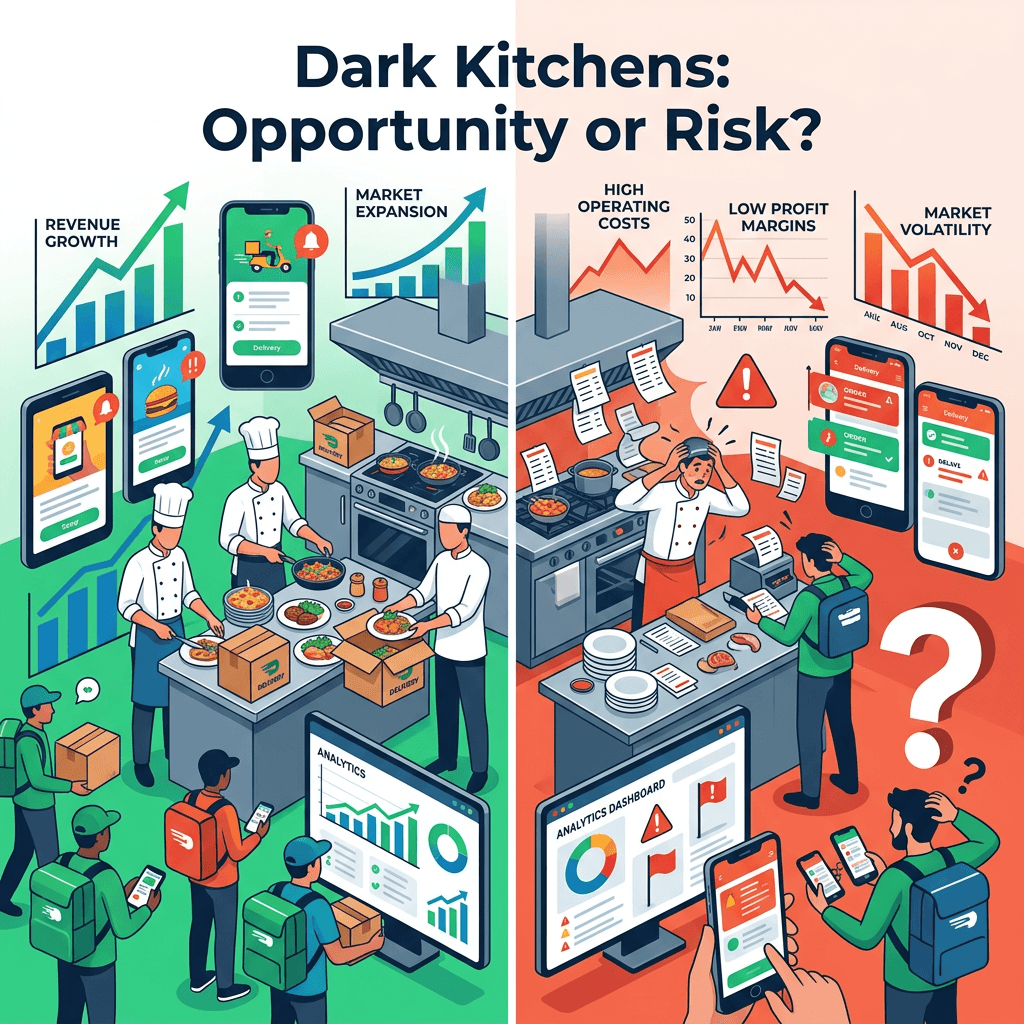

What if you could run a restaurant without expensive rent, front-of-house staff, or dine-in space—and still generate consistent revenue? This is exactly what dark kitchens are promising… but the reality is more complex.
The restaurant industry has undergone a seismic shift, with the rise of "dark kitchens"—also known as ghost, cloud, or virtual kitchens—leading the charge. By stripping away the traditional dining room, this model focuses exclusively on off-premise consumption, relying entirely on delivery apps like Zomato and Swiggy and digital presence. As this model reshapes urban food delivery, restaurateurs are left asking a critical question: is this a path to sustainable profit, or an operational trap?
The Allure of the Ghost Kitchen Model
The primary driver behind the surge in dark kitchens is the significant reduction in overhead costs. Traditional brick-and-mortar establishments often struggle with high real estate costs in prime, high-traffic locations, not to mention the expenses associated with maintaining front-of-house staff, furniture, and decor. In a dark kitchen, these costs are essentially eliminated, allowing operators to focus their capital on high-quality kitchen equipment and core food production.
Furthermore, the barrier to entry is substantially lower. For entrepreneurs looking to test new concepts or scale existing ones, dark kitchens offer unparalleled flexibility. Because the business exists solely on digital platforms, an operator can pivot their menu, rebrand, or even relocate with minimal logistical friction compared to traditional restaurants.
This agility is supported by modern technology, such as the Zilicius platform, which serves as a comprehensive management system to keep kitchen operations running smoothly. By integrating order intake, inventory tracking, and CRM functions into one centralised management system, owners can minimize the human error often associated with managing high-volume delivery demand.
Navigating the Operational Risks
While the financial upside is compelling, the dark kitchen model is not without its perils. The most significant challenge is the complete reliance on digital visibility. Unlike a storefront, a dark kitchen cannot rely on foot traffic or neighborhood presence to attract customers.
This forces owners to invest heavily in digital marketing, social media advertising, and search engine optimization just to remain relevant on crowded delivery aggregators.
Building customer loyalty is equally difficult when the interaction is reduced to a receipt and a delivery driver. Without the ambiance or personal service of a physical dining space, the brand must rely entirely on food consistency and delivery speed to earn repeat business.
Additionally, there are rising concerns regarding regulatory oversight and food safety. Because many dark kitchens operate in shared spaces with multiple trading names, they are harder for environmental health officers to monitor, creating potential bottlenecks in maintaining consistent safety standards.
Integrating Technology for Success
Operational efficiency is the thin line between success and failure in a delivery-only environment. In an industry where a single missed order or a delayed update to an online menu can ruin a reputation, technology becomes the most vital asset. A robust management system like Zilicius is essential for balancing these demands. It provides the necessary oversight to handle high-turnover staffing, synchronize multiple online storefronts, and manage the complexity of shared kitchen infrastructure.
By utilizing a sophisticated management system, operators can:
Streamline order intake from multiple delivery aggregators into a single interface.
Optimize inventory levels in real-time, reducing food waste and procurement costs.
Track performance metrics across different restaurant brands operating under the same roof.
Enhance staff communication to ensure that even during peak rushes, the kitchen maintains high output standards.
If you’re planning to start or scale a dark kitchen, the biggest difference between success and failure lies in how well your operations are managed. A centralized system that gives you full control over orders, inventory, and performance can make that difference.
The Verdict: Calculated Expansion
Ultimately, the dark kitchen model represents a massive opportunity for data-driven entrepreneurs, provided they approach it with a structured plan. The key to mitigating the risks lies in moving away from manual, reactive management and adopting a proactive, technology-first approach. By leveraging the Zilicius restaurant management system, restaurant owners can convert their kitchens into high-efficiency hubs that are capable of scaling alongside consumer demand.
The "dark" aspect of these kitchens does not have to mean a lack of transparency or control. When backed by the right systems, a dark kitchen becomes an agile, highly profitable engine that can dominate the modern delivery market. For those willing to master the digital landscape and invest in precise operational tools, the transition to a virtual model is less of a risk and more of a strategic evolution in the future of food service.
In the end, success in the dark kitchen model doesn’t depend on the idea—it depends on how efficiently you execute it.
Also Read