
Introduction: The Kitchen Is Where It All Happens
Every great dining experience starts long before the food hits the table. It starts at the pass — the moment a ticket lands in your kitchen and your team springs into action. Yet one of the most overlooked decisions in restaurant operations is deceptively simple: how do you communicate orders from the front of house to the back?
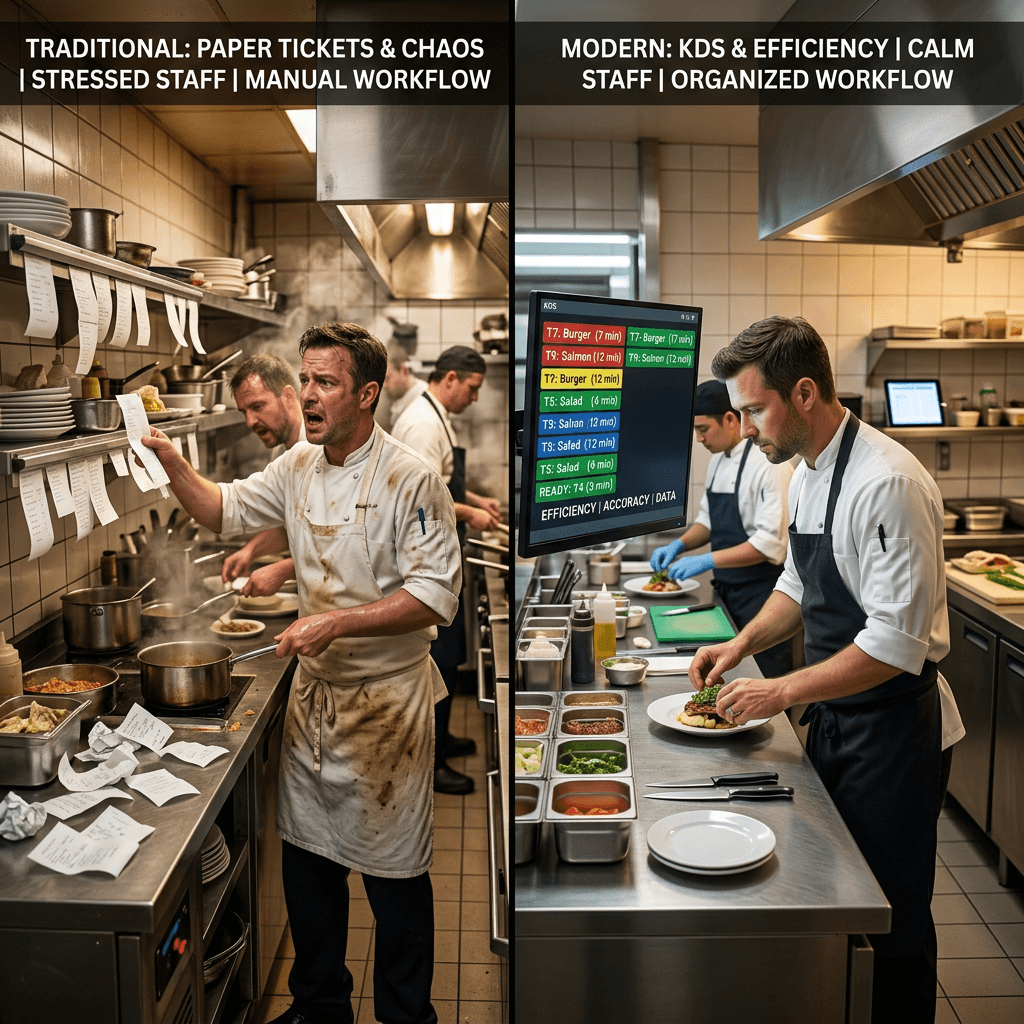
For decades, the answer was paper. Printed or handwritten tickets hung on rails, barked at by expo staff, and occasionally lost in the chaos of a Saturday dinner rush. Today, a growing number of restaurants are switching to Kitchen Display Systems (KDS) — digital screens that receive, display, and track orders in real time.
But which approach is actually better for your restaurant? And how does the right restaurant management system factor into the decision?
Let's break it all down.
What Is a Kitchen Display System (KDS)?
A Kitchen Display System is a digital screen — typically mounted on a wall or above a prep station — that displays incoming orders directly from your restaurant POS system or order management platform. Instead of printing a ticket, the system routes order information digitally, often colour-coded by timing, station, or order type.
A modern digital kitchen display system helps restaurants improve order flow, reduce communication gaps, and manage kitchen operations more efficiently.
Modern KDS solutions like those integrated with Zilicius restaurant management software can:
Display orders in real time across multiple kitchen stations
Colour-code items by urgency (e.g., orders approaching a time threshold turn red)
Allow kitchen staff to mark individual items or full orders as complete
Sync with front-of-house systems so servers know when food is ready
Generate data reports on ticket times, bottlenecks, and kitchen performance
Automatically improve communication between kitchen staff, servers, and delivery teams
Support faster kitchen coordination during peak restaurant hours
What Are Paper Tickets in Restaurant Kitchens?
Paper tickets are the traditional method: when a customer places an order, it is either handwritten or printed by a receipt printer and physically passed to the kitchen. The ticket hangs on a rail or is clipped to a board, and kitchen staff work through orders sequentially.
While the method is time-tested, it comes with real operational limitations — limitations that become harder to ignore as order volumes grow, menus get more complex, and customer expectations rise.
As restaurants scale operations, manual ticket handling often becomes a major operational bottleneck.
KDS vs Paper Tickets: A Head-to-Head Comparison
1. Speed and Efficiency
Paper tickets rely on physical handoff. Tickets can bunch up at the printer, get picked up out of order, or — in a busy service — fall to the floor. Any delay at the printer translates directly to a delay in the kitchen.
KDS eliminates this friction entirely. Orders appear on screen the instant they are placed, routed automatically to the correct station. There is no printing lag, no paper jams, and no waiting for a runner to carry a ticket across a busy kitchen.
A kitchen order management system helps restaurants streamline ticket flow and improve kitchen productivity during high-volume service hours.
For high-volume restaurants, the difference in speed can be measurable in minutes — and in a busy service, minutes matter.
Even small reductions in preparation delays can significantly improve table turnover and customer satisfaction.
Winner: KDS
2. Order Accuracy and Error Reduction
Paper tickets are only as accurate as the person writing or printing them — and only as legible as the handwriting allows. In a loud, hot, fast-moving kitchen, misread modifiers and skipped special requests are common sources of remakes and complaints.
With a digital kitchen display system, orders are transmitted exactly as entered at the POS. Dietary modifications, allergen flags, and special instructions appear clearly on screen. Some systems, including those powered by Zilicius, can even highlight allergy notes with a distinct colour or icon to ensure nothing is missed.
Studies consistently show that order communication errors are among the leading causes of food remakes and customer dissatisfaction in restaurants.
Fewer errors mean fewer remakes, less food waste, and happier guests.
Winner: KDS
3. Real-Time Order Tracking and Timing
One of the most powerful advantages of a KDS is real-time order tracking. Kitchen managers can see at a glance which orders are in progress, which are ready, and which are running behind. Colour-coded timers create a visual urgency system that paper simply cannot replicate.
With paper tickets, tracking order times requires manual effort — someone watching the clock or physically annotating tickets. In a fast-paced environment, this rarely happens consistently.
Zilicius restaurant management software takes this a step further, logging ticket times and surfacing reports that help you identify peak pressure points and optimise staffing and prep workflows accordingly.
Winner: KDS
4. Cost and Long-Term ROI
This is where paper tickets have a genuine advantage — at least upfront.
A thermal receipt printer costs a fraction of a KDS screen setup. There is no software to license, no hardware to mount, and no staff training required beyond what kitchen teams already know.
For very small restaurants, pop-ups, or operations with limited budgets, paper tickets can be a perfectly functional starting point.
However, the long-term cost calculation shifts quickly. Paper rolls, printer maintenance, and the hidden cost of order errors and slow ticket times all add up. Many operators find that the ROI on a KDS — measured in reduced waste, faster table turns, and fewer comps — pays for the hardware within months.
Winner: Paper Tickets (short-term cost), KDS (long-term ROI)
5. Staff Training and Ease of Use
Paper tickets require virtually no training. Every kitchen worker understands the system immediately.
KDS screens do require a short onboarding period, but modern systems are designed to be intuitive. A well-configured KDS with a clean UI — like the displays supported within the Zilicius ecosystem — typically sees full team adoption within a week of installation.
Winner: Paper Tickets (initially), KDS (once adopted)
6. Sustainability and Waste Reduction
This one is straightforward. Paper tickets generate continuous waste — rolls of thermal paper, most of which is not recyclable due to BPA coatings. For restaurants with sustainability goals or eco-conscious branding, this is worth considering.
KDS systems produce zero paper waste after installation.
Switching to a digital kitchen display system also supports environmentally responsible restaurant operations.
Winner: KDS
7. Integration with Your Restaurant Management System
A paper-based kitchen operates in relative isolation. Your front-of-house team has no real-time visibility into kitchen progress, and your manager has no data on how long orders are actually taking.
A KDS connected to a full restaurant management system like Zilicius creates a unified operational loop. Orders flow automatically from the POS to the kitchen. Servers receive notifications when food is ready. Managers access live dashboards and historical reports. Inventory can even be updated automatically as items are prepared.
This integration is where the KDS stops being just a display and becomes the central nervous system of your kitchen operation.
Winner: KDS
When Should Restaurants Still Use Paper Tickets?
Despite the clear advantages of KDS for most restaurants, paper tickets are not obsolete. There are scenarios where they remain a reasonable choice:
Very small or low-volume operations where ticket management is never a bottleneck
Pop-ups and temporary setups where installing a screen is impractical
Backup systems — many KDS-equipped kitchens keep a printer available as a failsafe
Operators with extremely tight startup budgets who plan to migrate to KDS as revenue grows
The key is understanding where your operation sits today — and where you want it to go.
How Zilicius Kitchen Display System Improves Restaurant Operations
Zilicius is built from the ground up as an integrated restaurant management system, which means KDS functionality is not a bolt-on feature — it is core to how the platform works.
When you run your kitchen on Zilicius:
Orders are instant. The moment a server submits an order or a customer completes an online order, it appears on the relevant kitchen station screen. No delay. No reprinting.
Routing is intelligent. Different items go to different stations automatically — hot food to the grill station, cold starters to prep, desserts to pastry — without any manual intervention.
Timing is visible. Every order is time-stamped. Colour coding tells your team which tickets need immediate attention. Managers see a live view of kitchen throughput at any moment.
Data drives decisions. Zilicius surfaces ticket time reports, peak hour analysis, and station-level performance data so you can continuously improve your kitchen's efficiency.
Integration is seamless. Because Zilicius connects front-of-house, kitchen, and management in one platform, your entire operation stays in sync — from the moment a guest orders to the moment they receive the bill.
Why Modern Restaurants Are Switching to Digital Kitchen Display Systems
Customer expectations are evolving rapidly. Restaurants today are expected to deliver:
Faster service
Accurate orders
Better delivery coordination
Real-time communication
Consistent dining experiences
Traditional paper ticket systems struggle to support these modern operational demands.
A digital kitchen display system helps restaurants operate with greater speed, precision, and scalability.
As restaurant operations become more technology-driven, KDS adoption is quickly becoming an industry standard rather than an optional upgrade.
Final Verdict: Is KDS Better Than Paper Tickets?
For most restaurants — whether you are running a 30-cover neighbourhood bistro or a 200-cover multi-station operation — a Kitchen Display System delivers meaningful advantages over paper tickets in speed, accuracy, data, and sustainability.
The upfront investment is real, but so is the return. Faster ticket times mean faster table turns. Fewer errors mean fewer remakes and lower food costs. Better data means smarter staffing and prep decisions.
And when your KDS is powered by a full-stack restaurant management system like Zilicius, you are not just replacing paper — you are building a kitchen operation that scales with your ambitions.
Digital kitchen operations are rapidly becoming the industry standard for modern restaurants.
Ready to Upgrade Your Kitchen?
With Zilicius Restaurant Management Software, restaurants can:
1. Reduce kitchen errors
2. Improve order speed
3. Track ticket times in real time
4. Connect POS, kitchen, and billing in one platform
5. Improve kitchen communication and efficiency
6. Reduce operational delays and food wastage
7. Scale restaurant operations with confidence
Zilicius helps restaurants of all sizes run smarter, faster, and more profitably. From KDS integration to full front-of-house and back-office management, our platform is designed around the real challenges of running a modern restaurant.
Explore Zilicius today and see how a connected kitchen can transform your operation.
Also Read
Progressive Web Apps (PWA): The Future of Web Development